
























Mental health awareness has increased in recent years; congratulations, our society has accomplished the bare minimum. It is still not acknowledged enough.
Many people talk about the negative impacts of poor mental health, such as unfavorable self-image and the effects on physical health that it can lead to. It is so important to share emotions verbally and to also make sure you check up with friends, family members or someone close to you.
This discussion will not cover the effects of negative mental health, but instead the positive effects. A positive mindset enhances your overall well being. It is just as important to talk about the positives as well as the negatives that affect someone’s life.
An article by Hopkins Medicine, “The Power of Positive Thinking,”, mentioned that researchers believe positivity is linked strongly to health. The article states, “Studies have found that a positive attitude improves outcomes and life satisfaction across a spectrum of conditions– including traumatic brain injury, stroke and brain tumors.”
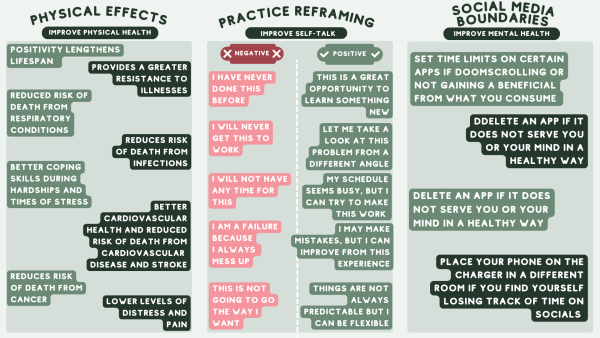
Not only can positivity improve your mood, but also your health. An article by Mayo Clinic, “Positive thinking: Stop negative self-talk to reduce stress,” provided a long list of physical effects on positivity. Some of the things included in that list were increased life span, a greater resistance to illness and reduced risk of death from cancer, respiratory conditions and infections. The article also states that their findings are not simply cut and dry.
“It’s unclear why people who engage in positive thinking experience these health benefits. One theory is that having a positive outlook enables you to cope better with stressful situations, which reduces the harmful health effects of stress on your body,” the article states.
Reducing negative thoughts and attempting to frame more positivity from day-to-day sounds easier than it looks. There can be so many factors that play into how someone can feel. The grief of losing a loved one, the disappointment of not landing that job, a traumatic event, financial issues; the list can go on. Sometimes people are just not in the mood to be happy.
As college students, we have experienced anxiety, stress, fear and burnout. With the experience of these emotions, it has taught us what we are capable of, personal limits and what we need to do to reset and take care of ourselves. A few things we can do personally are to hang out with friends or family, treat ourselves to a spa night, read a book, go on a walk or watch that movie that your friends have begged you to see.
When projects or tasks stress someone out, try to take time to check off those tasks to help relax. Try to avoid procrastination. When someone has been working hard for a while and they need time away from tasks, reach out and connect with friends and allow yourself to have fun. This has not come easy for everyone, and it may take some time to understand what works best for everyone.
Many people deal with emotions in various ways, and there is not one quick fix or solution to balance everyone’s life.
One way to improve overall mental health is to practice. The article by Hopkins Medicine believes that practice can help improve your mindset.
“Practice reframing. Instead of stressing about a traffic jam, for instance, appreciate the fact that you can afford a car and get to spend a few extra minutes listening to music or the news, accepting that there is absolutely nothing you can do about the traffic.”
This is just one example Hopkins Medicine provided. If you are stressed about college finals, slow your mind and reflect on the big picture. Students are fortunate to get a high-level education that challenges their skills and knowledge to help improve their mind. Flip the narrative. Instead of giving power to what you are afraid of, embrace it to push yourself forward.
In the article by Mayo Clinic, it is important to embrace positive self-talk and thoughts. “Positive thinking doesn’t mean that you ignore life’s less pleasant situations. Positive thinking just means that you approach unpleasantness in a more positive and productive way. You think the best is going to happen, not the worst.”
It is difficult to ignore the problems that are in motion anywhere in life. Shift your personal thoughts or emotional situations in a beneficial way.
One of the biggest mental health factors, specifically in today’s modern world, is social media addiction. The University of Maine reported that there are roughly 4.8 billion social media users globally, which makes up 59% of the entire population. Our tablets and phones are constantly with us at work, in class, running errands and right next to our beds when we fall asleep at night and wake up the next morning.
Social media can be a positive experience if boundaries are set. Some ways to get away from comparisons or doom scrolling can be setting time limits, unfollowing specific users or people that make you feel bad or just deleting and re-downloading apps when you are ready to take a look at what’s going on online.
An article by the UC Davis Health, “Social media’s impact on our mental health tips to use it safely,” mentioned that social media can release amounts of dopamine to the brain when using a social platform.
“The addictive nature of social media activates the brain’s reward center by releasing dopamine. This is a “feel-good chemical” linked to pleasurable activities,” states the UC Davis Health article. “When we post something, our friends and family can “like” it, giving us a boost of dopamine. However, when we don’t get that boost or approval, it can impact our sense of self and adequacy.”
Give yourself a break. With how much time we spend on social platforms, the brain can receive numerous amounts of dopamine like never before. Some peope benefit the most from setting time limits on their phone, to even deleting an app for a month just to give themselves some air. Social media usage can be healthy; it just depends on how you utilize it and how much of your energy you are putting towards it.
Quick recap. Positivity can give you multiple health benefits. Focusing on the negatives can risk your physical health. Do the things you love, understand what you need to do to keep yourself sane and give positive self-talk practice a shot instead of unnecessary complaints that will only make you feel worse. Just once in a while, put down the phone for a positive and balanced life.
It really comes down to the work you are willing to commit to, to heal areas of your mind and break unhealthy habits. It is just as important to talk about the positives, even arguably, more important than focusing on the negatives.