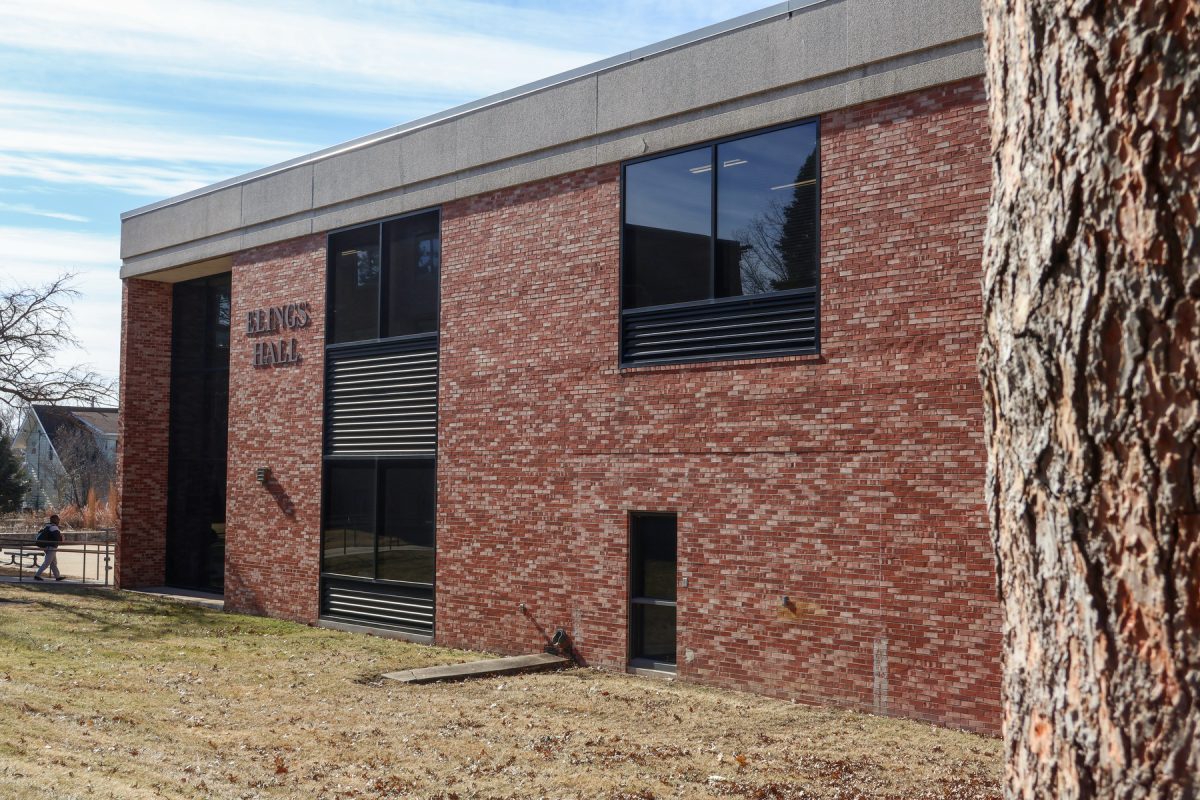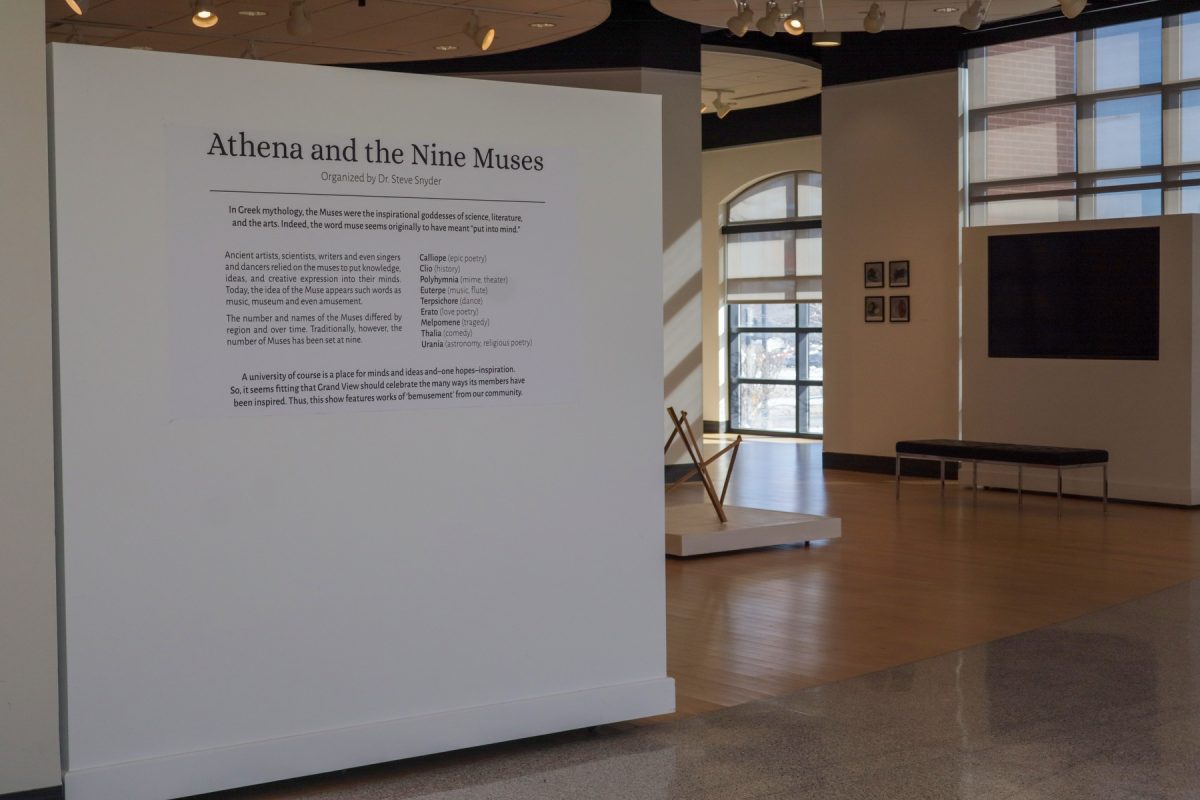
Many students at Grand View University pass through the Rasmussen Center daily without realizing it houses a dedicated art gallery showcasing creative works from faculty, staff and even fellow students. Director of the GV Complete Program Beth Carlson and professor Steve Snyder of the Humanities Department highlight how the space serves as both a platform for sharing personal creative outlets and a space for fostering connections across the campus community.
“I started crocheting… I took a class in 2014,” Carlson said. “And then I basically supplemented that with YouTube videos and just started doing it as a creative outlet.”
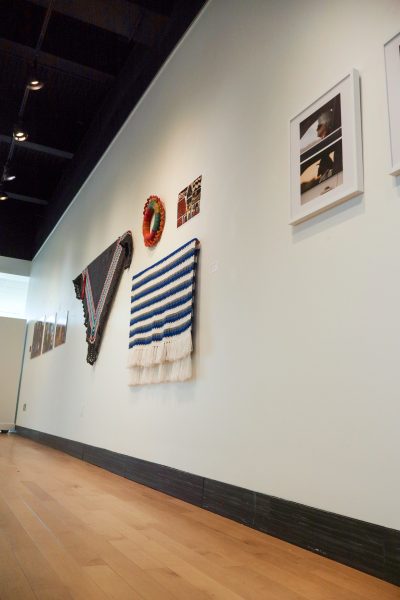
The gallery features a variety of submissions from faculty and staff, including crocheted items, photography, textile art, scientific models and more. Carlson contributed several pieces to this exhibit, such as a Nordic shawl, a throw blanket and a wreath, all of which she crocheted by hand.
She explained that crocheting provides her with both artistic expression and relaxation, often paired with some music or a good audiobook. Beth has made multiple blankets in college colors for her nieces and nephews upon high school graduation, and she even entered a shawl in the Iowa State Fair’s “Fabric and Threads” Crochet Division, where it earned second place in the competition.
Kylie Arai
According to Carlson, the shawl has a Nordic feel, reflecting her Swedish and Norwegian heritage, while the displayed blanket was made for a niece attending Drake University.
Snyder described some other diverse contributions, even coming from the science and math departments, with mathematical sculptures and scientific models.
“Somebody from the science department brought in an autoclave, and they had this old autoclave that’s been hanging around down there,” Snyder said. “I think somebody has some textile art on the wall, and there are some photographs of science. There’s a model of a COVID molecule or enzyme.”
Snyder emphasized that many artists in various backgrounds fall into this gratifying “flow” state during the creative process, where time stands still during focused activities. For instance, we may get a flow state when creating or enjoying art.
“That state, it’s called flow,” Snyder said. “You are doing something that takes a lot of skill and a lot of focus. And what the research on flow is, there’s quite a lot of research on flow, is that people find that extremely gratifying. It makes them feel good.”
The Rasmussen Center show originated from a conversation between Snyder and his colleague Rachel Schwaller, who proposed showcasing items that reflect personal sources of inspiration. Snyder suggested centering the display on the nine Muses from Greek mythology which consists of multiple disciplines including art, science, astronomy, music and dance.
“And so she asked me if I’d like to do that, and I said, sure! Then we started talking around some ideas for a theme and I thought it would be fun to have a show in which faculty and staff, and maybe even some students, could submit things… things that inspire them,” Snyder said. “And so that made me think of in Greek Mythology, there are these muses, nine muses. The nine muses are these spirits that come and inspire people. They aren’t just for art; they’re for science, astronomy, music and dancing.”
Initially, the exhibit opened with an event featuring the choir, allowing attendees to appreciate colleagues’ inspirations. Submissions were collected through a meeting with faculty, with nearly everything accepted to fill the space. “I believe that Steve and Rachel invited us at a faculty meeting initially, and explained what they were trying to do,” Carlson said.
A call for submissions was issued to faculty and staff last fall, with items due by the end of December. Snyder mentioned that he was pleasantly surprised by the response. Snyder said, “I’ll be honest, I didn’t really know if anyone would do it.”
Snyder also credited Schwaller with her effective approach to arranging the exhibit and her ability to provide visual guidance for people experiencing it for the first time.
“The part that intrigued me was the invitation came out from Steve, initially, for faculty and staff to contribute any creative outlets that we have. I think that’s always cool, in a campus community where students may know us in one role and not the other things that… feed us as people,” Carlson said. “I’ve really enjoyed walking around the exhibit and seeing the displays from other faculty and staff, because it does shed light on their creativity or parts of their personal life that I don’t know of as a colleague.”
The space connects with students, alumni and visitors by encouraging exploration of art and creativity, potentially inspiring off-campus visits to places like the Des Moines Art Center or Art Festival.
“I think that it is such a cool space that we have here on campus that anything that draws students here is really phenomenal,” Carlson said. “To see science professors, you know, maybe sharing some art, or others on campus opening up a bit about their personal life, I think that is good, I mean we’re all people.”
Carlson also advised openness when visiting: “Just being open-minded to experience it however you do, that’s the other thing. There’s a misconception that how you experience art is supposed to be a certain way, but it’s really a personal experience,” Carlson said.
To get involved with the gallery, monitor MyGVU announcements, posters or electronic notices for future calls, and consider submitting some work.
“Yeah, I just signed up, and responded to the all-call, but I think just paying attention to things, you know, MyGVU is a good place to see announcements,” Carlson said.
The Rasmussen art gallery stands as an underutilized resource promoting community and personal growth at GVU. Go experience it for yourself, learn about the people around you and maybe even gain an interest in something you might not know you had an interest in.