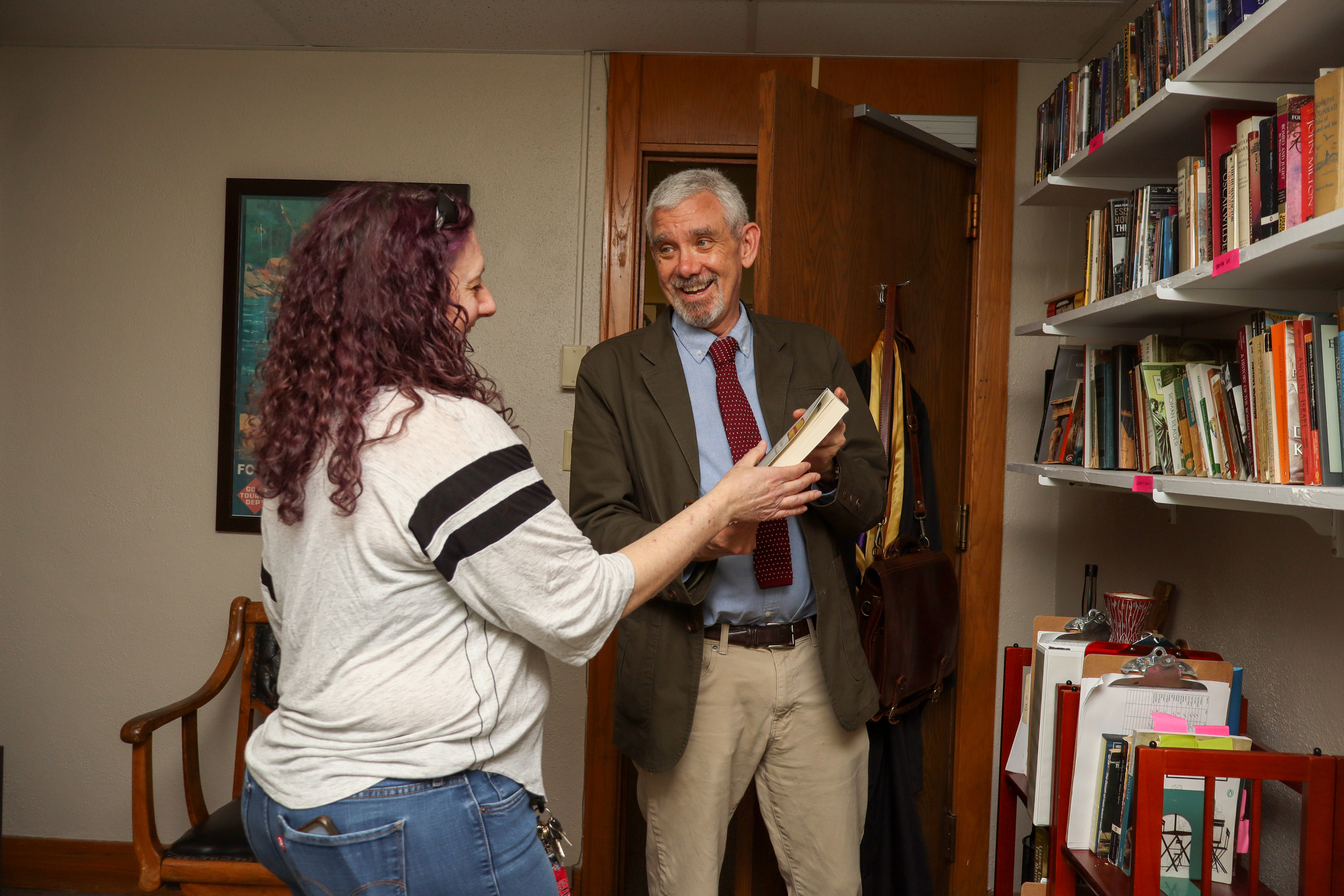
The internet, Super Nintendo Entertainment System (SNES), Sonic the Hedgehog and Gushers. These are all things that were released in 1991, the same year that humanities professor Steve Snyder began serving Grand View University (GVU). He has been teaching at GVU for 35 years and is reaching the tail-end of his final semester before retirement.
“When I first started it was 1991. I was half-time in the English department and half time in the communications department. I think the thing I remember about, your first year of teaching, you’re building everything from scratch,” Snyder said. “Mostly that first year was kind of awful. But I think that’s something that everybody goes through.” Snyder said.
But a lot of things can change in 35 years. The campus has changed, the buildings have changed and the people have changed. Although GV was founded in 1896, it did not become a university until 2008, a transition that Snyder experienced. But what did not change was his role. Although he moved in and out of different programs like English, Communication, Honors and Humanities, he remained a steady pillar for students.
“I never thought I was going to be a professor. I never set out to be a professor. It just kind of kept getting in front of me and I always say my vocation found me, I didn’t find it. I can’t think of anything else I would rather have done. I really can’t. I try to imagine what if I’d done this, what if I’d done that,” Snyder said.
Although Snyder had never initially intended to be a professor, it was a career that was a perfect match. Uniquely, his favorite thing to do is return assignments with comments on them, saying that it is like writing a personal letter to them. He likes to find ways to be creative in the classroom and keep students involved.
Kylie Arai (Kylie Arai)
“We need to double down on the human in our classrooms. Education is only done with human beings and human beings have potential. The point with human beings educating human beings is to help them flourish,” Snyder said. “It’s not to crank out more nurses, it’s not to crank out more accountants or graphic designers or physical trainers. Yes, we need those things, but what we really need is flourishing human beings who happen to have those jobs, and I think that sometimes we forget that. We forget that the real job of educating humans is to show them how to be humans.”
This kind of pedagogy is something that students remember. They are much more likely to remember a professor who did things like encourage every student to speak in class, have unique ways to present a lesson and provoked an interesting train of thought over a professor who was the smartest or had the most knowledge on their area of study.
With approximately 144 students every year, Snyder has seen a lot of different faces. In his last year, he taught Kit Adams, a junior theater major. It is their first time taking a class with Snyder.
The class Adams is taking is called Good and Evil and often walks away from class having had a profound conversation with both Snyder and their classmates. Adams said that Snyder makes the students think about things that they would have not typically thought about on a day-to-day basis. But there is more to Snyder than just provoking thought within the classroom.
“I’ve never met a person who is more insightful and thoughtful about the way he speaks to people and speaks about things. He takes time to answer questions, and you can see him thinking through his answer as he’s giving it. He’s very concise with his words, he knows exactly what he’s trying to communicate and communicates it very very well. I don’t think I’ve had a professor that has consistently made things so easy to understand, especially when it comes to consuming media you usually don’t consume,” Adams said.
“He’s kind and understanding to everybody. I think, especially when it comes to having to teach so many students, he takes time to learn something about everybody, and I think that’s really important especially in college. To know that somebody who is above you is taking time to learn about you,” Adams said.
Kylie Arai (Kylie Arai)
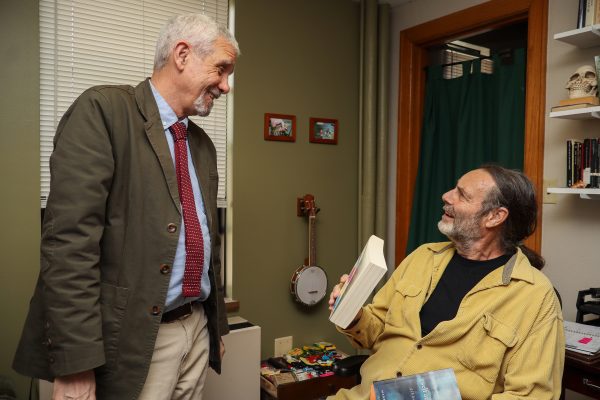
Snyder is not only kind and understanding to his students, but to his colleagues as well. Going into his last year of teaching before retiring, he found it too easy to look back with regret and grow bitter or resentful. Yet, this is not the kind of attitude that he wants to go out with. He thought that if he focused on things he was grateful for, any bitterness would be diluted with gratitude.
“I really tried in the last year to be very grateful. Grateful for all the little things that are so enjoyable about this job. Students. Laughing with them, sharing ideas with them, but I started in August, and I continued every month sitting down and writing a letter to a colleague just to tell them how grateful I am for them. I thought that a lot of times when you retire, you’re filled with regrets,” Snyder said.
How you will be remembered is a difficult idea to wrestle with for anybody, especially somebody with a career as long as Snyder. He has been working at GVU longer than most of his students have been alive. He has seen a lot of the school and the school has seen a lot of him; the good days, the bad days and everything in between.
“I hope that people remember that I was kind and considerate, although I’m sure, there were times I rubbed people the wrong way. I hope I’m remembered for being a kind and considerate colleague,” Snyder said.
Along with being remembered, there is also the idea of being forgotten. He says that in four years, all the students who have ever taken a class with him will be gone – in ten years, all his colleagues who worked alongside him will likely be gone. That being said, ideas live forever. Personality lives forever.
“It’ll be a really sad loss for Grand View to lose such an amazing professor and person, and we talked today in class about being forgotten after he leaves, and I really hope that doesn’t happen. Because I’m sure at least in the classroom, in the few months we had this class, he’s really made an impact on students in there and will continue to make impacts long after he’s gone,” Adams said.
Kylie Arai (Kylie Arai)
After retiring, Snyder plans on working on small short-term projects to keep busy like reconnecting with old hobbies like painting and writing. He says he knows himself well enough to not make too many ambitious long-term plans that he will never finish. He has a list in his journal of the projects he aims to work on.
So, what now? What kind of insight can someone like Snyder give us?
“Grand View works. Students come here, they go through this experience, and in many cases, it changes their lives. I’ve seen that happen. There are students that go through Grand View and their lives aren’t changed. I’m not saying that it happens automatically, but it does happen, and it happens in profound enough ways, and it happens often enough that this place really does work,” Snyder said. “This place works. This place is here. It’s not a bad place. It’s a good place to be.”